Astra review (2026): a fast theme inside a heavier ecosystem
Astra is fast in clean lab tests, yet only 40.9% of live sites pass mobile Core Web Vitals. We assess its architecture, pricing, security, and fit.
On this page The short version
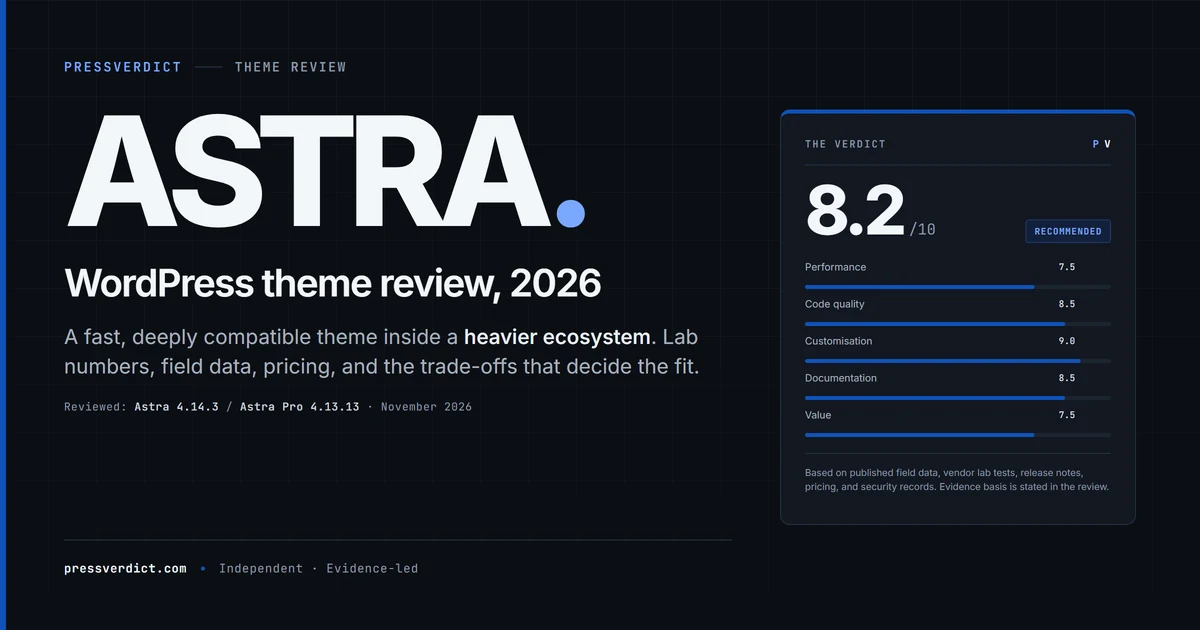
The verdict
Astra
Astra remains a dependable, broadly compatible theme with a capable free core, deep WooCommerce tooling, and an unusually ambitious MCP layer. Its lab footprint is competitive, but field data shows only 40.9% of live Astra sites pass mobile Core Web Vitals, and the 2026 licence structure penalises staging-heavy workflows. Buy it for Elementor, WooCommerce, or agency template work; do not buy it expecting the best free tier, native Full Site Editing, or the lowest cost per live site.
Best for
Elementor-led agencies, WooCommerce stores, and teams that want a mature classic/hybrid theme with a large template library, deep store controls, and optional AI-agent workflows.
Avoid if
You want native Full Site Editing, a free sticky header, the strongest real-world Core Web Vitals, or a 10-site licence that excludes local and staging environments.
Score breakdown
- Performance
- 7.5
- Code quality
- 8.5
- Customisation
- 9
- Documentation
- 8.5
- Value
- 7.5
- Vendor
- Brainstorm Force
- Version tested
- 4.14.3 / Astra Pro 4.13.13
Free core on WordPress.org. Astra Pro Addon Only: $59 first-year promotion and $69 renewal for three sites; lifetime $229 promotional or $349 regular. AI bundles: $149–$429 per year on renewal; lifetime $249–$1,299. Local, staging, and development sites count toward the limit. Prices are the published November 2026 USD rates and seasonal promotions vary.
What works
- Broad builder and plugin compatibility, with a classic PHP core that suits Elementor, WooCommerce, WPML, LearnDash, and BuddyPress.
- A capable free core: three-row header and footer builder, global colours, self-hosted Google Fonts, and a 74-ability MCP server.
- Deep WooCommerce tooling in Pro, including off-canvas filters, Quick View, a slide-in cart, modern checkout, and HPOS support.
- Prompt security patching on the core theme and a public responsible-disclosure posture.
- Astra Pro Addon Only remains strong value for a small number of sites at $59–$69 per year.
What does not
- Only 40.9% of 181,058 live Astra sites passed all three mobile Core Web Vitals in May 2026 field data, 12.1 points behind GeneratePress.
- The free tier withholds the sticky header, and Astra Pro does not include the Premium Starter Templates.
- Local, staging, and development activations count toward the site limit, which cuts the effective live-site allowance for staged workflows.
- AI bundle renewals rise by up to 88.6% after Year 1, and lifetime AI extras such as ZipWP hosting expire after three years.
- The Spectra Legacy to Spectra Blocks split has no automatic migration, and the Starter Templates plugin has a heavier CVE history than the theme.
Astra 4.14.3 is not the fastest WordPress theme in 2026, and it is no longer the cheapest way to put a professional site online. It is still one of the most broadly compatible themes available, with a free core that ships a visual header and footer builder, a large starter-template library, and — unusually for a theme — an MCP server that exposes 74 WordPress abilities to AI clients. The problem is not the code. It is the stack that tends to grow around it.
Only 40.9% of 181,058 live Astra sites passed all three mobile Core Web Vitals in May 2026 field data, 12.1 percentage points behind GeneratePress. The same pattern appears in the lab: Astra is competitive on a default install, but its ecosystem steers users toward Elementor, large starter templates, and plugin stacks that change the outcome. That contradiction — a lean theme with a heavy typical deployment — is the centre of this review.
The short version
Astra is a strong choice when the site is built around Elementor, WooCommerce, or a multi-builder agency workflow. Its classic PHP foundation is an asset in those stacks, not a legacy defect. The free core covers more than most themes do, and Astra Pro replaces several standalone plugins with a coherent WooCommerce layer.
It is a weaker choice when the priority is the best free tier, native Full Site Editing, or the lowest cost per live site. The sticky header is Pro-only. Premium Starter Templates are not included with Pro. Staging sites count against the licence. And the AI bundles that now dominate the pricing page renew at rates that can nearly double after Year 1.
Astra in 2026: market position and product shape
Astra is maintained by Brainstorm Force, based in Pune, India. The current releases are Astra 4.14.3 and Astra Pro 4.13.13, both updated on 12 November 2026. The free theme has more than 1 million active installations on WordPress.org; BuiltWith detects more than 3.4 million live sites, and Astra is the second most common WordPress theme among the top 1 million sites, with 7.44% of that set, or 14,182 sites.
The public ratings are strong but not uniform. WordPress.org shows 4.9 out of 5 across 6,559 reviews, including 6,319 five-star ratings (96.34%) and 104 one-star ratings (1.59%). Trustpilot shows a 3.8 out of 5 TrustScore across 1,998 reviews, even though 96.30% of those reviews are five stars. The gap is a recency-weighting effect, not a different product: Trustpilot notes that the company has no recent history of inviting reviews, so recent organic complaints carry more weight.
| Developer | Brainstorm Force (Pune, India) |
|---|---|
| Current versions | Astra 4.14.3 / Astra Pro 4.13.13 (12 November 2026) |
| Architecture | Classic/hybrid: theme.json, React Customizer, Site Builder in Pro; no native FSE |
| Market presence | 1M+ active on WordPress.org; 3,409,114 live sites (BuiltWith); #2 theme in the top 1M sites (7.44%, 14,182 sites) |
| WordPress.org rating | 4.9/5 from 6,559 reviews (96.34% five-star) |
| Trustpilot rating | 3.8/5 TrustScore from 1,998 reviews (96.30% five-star) |
| Minimum requirements | WordPress 5.3+ and PHP 5.3+; MCP requires WordPress 6.9+; Spectra Blocks requires PHP 8.1+ |
| Free core | Header/footer builder, global colours, self-hosted Google Fonts, 100–130+ free Starter Templates, MCP server |
| Paid entry point | Astra Pro Addon Only: $59 first-year promotion / $69 renewal for 3 sites |
Market and rating figures are the source data published in November 2026. Ratings move; check the live directory before citing them.
Architecture: a classic core with modern bridges
The most persistent misconception about Astra is that it became a Full Site Editing theme somewhere in the WordPress 6.x cycle. It did not. The WordPress.org source still relies on traditional PHP templates: header.php, footer.php, single.php, archive.php, sidebar.php, and template-parts/. Astra adopted theme.json early to synchronise its global palette and block settings with Gutenberg, but it does not ship the templates/ and parts/ directories that define a block theme.
That hybrid design cuts both ways. For a site built on Elementor, complex WooCommerce extensions, WPML, LearnDash, or BuddyPress, the classic foundation is an advantage. Forcing Elementor onto a pure FSE theme fights the Site Editor’s architecture. For a team standardising on the native Site Editor without extra builders, Astra is the wrong starting point. Brainstorm Force acknowledges the gap by positioning its separate free block theme, Spectra One, as its FSE offering. Spectra One has a modest 7,000+ active installations (version 1.2.6, updated August 2026) compared with Astra itself.
| Feature | Astra (hybrid) | Native FSE block theme |
|---|---|---|
| Layout control | PHP templates + React Customizer + Site Builder | Block templates + Site Editor |
| theme.json global styles | Yes | Yes |
| templates/ and parts/ directories | No | Yes |
| Native Full Site Editing | No | Yes |
| Elementor-first workflow | Strong fit | Fights the Site Editor |
| Classic plugin compatibility | Broad: WPML, LearnDash, BuddyPress, WooCommerce extensions | Varies by plugin |
| Lock-in when switching themes | Low on core + block editor; higher with Site Builder and Spectra Legacy | Low: content remains standard blocks |
Based on the published architecture analysis in the source material, not a first-party code audit. A native block theme can still run Elementor, but the two editing models compete for control of the same templates.
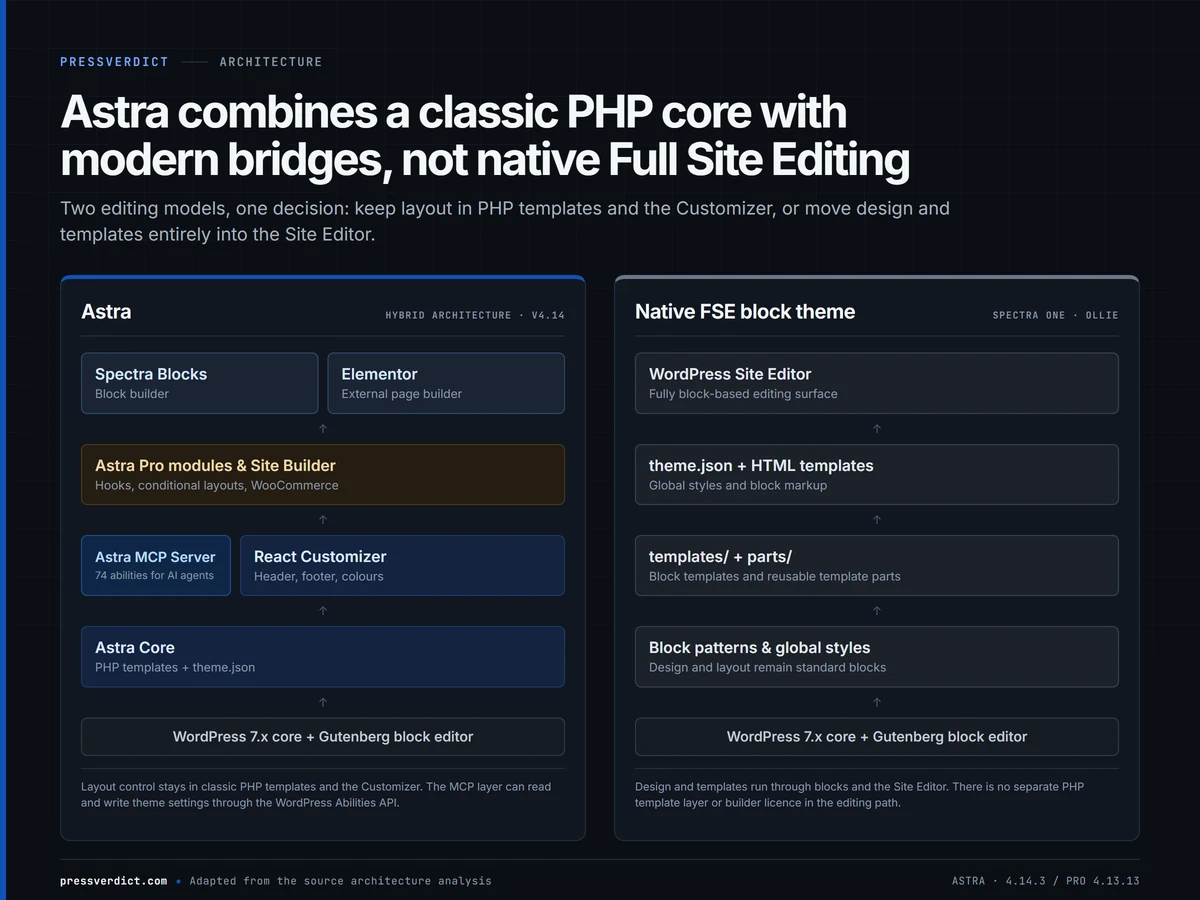
Astra’s hybrid architecture (v4.14) keeps layout in PHP templates and the React Customizer, with Pro modules and an MCP layer above it. A native block theme routes design and templates through the Site Editor. Adapted from the architecture analysis in the source material. Open the full-size diagram.
The practical question is not which model is more modern. It is which model matches the team that has to maintain the site. A classic theme with a visual header builder is easier for an Elementor agency to hand over. A block theme is easier for a team that wants one editing surface and no builder licence. Astra is deliberately optimised for the first case.
The 2025–2026 release record
The claim that Astra’s development has stalled does not survive the release history. Brainstorm Force shipped meaningful work on four fronts in 2025 and 2026, although several strategic pivots created transition friction.
The Customizer cleanup
In May 2025, Astra 4.11.0 reorganised the Customizer. Separate sections for blog, pages, search results, and custom post types moved under a unified Post Types panel, while site-wide options such as Accessibility, Breadcrumbs, and Scroll to Top moved into a new General panel. The change reduced a long, crowded sidebar, but it also moved familiar controls, which is why some long-time users experienced it as churn rather than cleanup.
Astra also built a Dark Color Palette across versions 4.9.0 and 4.10.0, then paired it with the Color Switcher in Astra Pro, highlighted in June 2026. Astra 4.14.0 (September 2026) added support for up to nine custom-named brand colours that sync across Gutenberg, Elementor, and Astra’s own colour pickers. For agencies maintaining a design system across multiple builders, that is a quiet but useful improvement.
The MCP server is the real 2026 headline
The most distinctive feature of Astra’s 2026 releases is free, not paid. The Astra MCP Server, available since Astra 4.13.0, is built on the WordPress Abilities API introduced in WordPress 6.9. It exposes 74 typed abilities through the Model Context Protocol at /wp-json/astra/v1/mcp, allowing AI clients such as Claude Code, Claude Desktop, Cursor, Windsurf, and VS Code to inspect or update fonts, colour palettes, buttons, header rows, and blog layouts in plain language.
Access is gated by three separate toggles — Enable Abilities, Enable MCP Server, and Enable Edit Abilities — all disabled by default. The integration honours existing WordPress capabilities such as edit_theme_options and authenticates through WordPress Application Passwords. Three caveats matter before anyone points an agent at a live site:
- The official WordPress MCP Adapter is still experimental.
- Changes save directly to the live site; there is no draft preview.
- Astra Pro settings are not yet covered by the integration.
For a solo builder, the MCP server is a promising convenience. For an agency, it is a governance question. The ability to change global colours and header rows through an AI client is powerful, and it needs the same change control as any other production write. Start with edit abilities disabled, test on a staging copy, and keep an audit trail of what the agent changed.
Spectra Legacy, Spectra Blocks, and the migration nobody gets for free
In July 2026, Brainstorm Force split its Gutenberg block builder into two plugins. The original plugin, with more than 1 million installs, became Spectra Legacy and now receives maintenance and security patches only. New feature work moved to Spectra Blocks, a ground-up rebuild at version 1.0.15 in November 2026 with 50,000+ installs, requiring PHP 8.1+ and WordPress 6.6+.
Existing sites keep working, but there is no automatic migration. Global colours and block defaults are not shared between the two plugins. Custom CSS that targets Legacy classes must be rewritten. A phased migration means running both plugins side by side. Spectra Blocks’ AI page generator also relies on a separate Zip AI companion plugin and ZipWP credits, even for paying Spectra Blocks Pro subscribers.
The split is understandable as a technical reset. It is still a migration project disguised as a plugin update, and agencies should price it as one.
Beaver Builder and the template direction
In February 2025, Astra began sunsetting Beaver Builder support inside Starter Templates. The theme itself still supports Beaver Builder, and existing websites are unaffected. New templates focus on Elementor, Spectra, and ZipWP AI. The signal is clear: Astra’s template roadmap is no longer builder-neutral, even if the theme is.
Performance: strong lab numbers, weaker field outcomes
No topic around Astra is repeated more often, or misinterpreted more frequently, than speed. Brainstorm Force markets the theme as loading under 50 KB of frontend assets, running without jQuery (pure vanilla JavaScript), and loading in 0.5 seconds. On a bare default install, those core claims largely hold up. In the wild, aggregated real-user telemetry tells a different story.
What the lab benchmarks show
In WP Astra’s own benchmark from October 2026, all themes ran on identical installs with WordPress 7.1.3, Elementor 4.3.5, and WooCommerce 11.2.1, without caching. Astra 4.14.1 tied for the highest median mobile PageSpeed score at 97, alongside Kadence, ahead of GeneratePress (94), Neve (93), and Blocksy (92).
GeneratePress still won every fixed payload metric in that test: 104.9 KB transferred, 1.84 s LCP, and 7.2 KB of theme-owned JavaScript, against 127.8 KB, 1.99 s LCP, and 26.3 KB of uncompressed theme JavaScript (5.7 KB compressed) for Astra. Astra’s score is strong; its payload is not the smallest.
| GeneratePress | 104.9 KB · mobile PSI 94 |
|---|---|
| Neve | 121.3 KB · mobile PSI 93 |
| Blocksy | 126.0 KB · mobile PSI 92 |
| Kadence | 126.6 KB · mobile PSI 97 |
| Astra | 127.8 KB · mobile PSI 97 (tied highest PSI) |
| Hello Elementor | 151.8 KB · mobile PSI 88 |
| Twenty Twenty-Five | 160.7 KB · mobile PSI 89 |
| OceanWP | 421.0 KB · mobile PSI 90 |
Identical default installs on WordPress 7.1.3, Elementor 4.3.5, and WooCommerce 11.2.1, with no caching. Bricks and Divi were not included. This is a vendor benchmark from Brainstorm Force, so treat the ranking as directional.
Independent tests produce different winners, which is normal when hosts, PHP versions, and cache states differ. In caching vendor WP Rocket’s 2026 theme test on an OVH server in France with PHP 8.0, Astra placed first overall with a 91/100 mobile score, 1.9 s fully loaded time, 1.8 s LCP, 870 KB total page size, and 11 HTTP requests. It edged out Hello Elementor (90/100, 1.9 s), Kadence (89/100, 2.8 s), OceanWP (88/100, 2.9 s), and GeneratePress (87/100, 2.5 s).
Themeisle’s benchmark, measured in June 2025 and updated editorially in 2026, ranked Astra fifth at 719 ms fully loaded with 16 requests, behind Neve, Kadence, GeneratePress, and Hello Biz. NitroPack’s 2026 test recorded 48.5 KB and 100/100 mobile for Astra, but 88 on desktop and 85% on GTmetrix, trailing Twenty Twenty-Three (26.3 KB) and GeneratePress (37.7 KB).
The honest reading is that Astra’s core is consistently competitive but rarely the absolute lightest. The leader depends on the rig. That is not a marketing failure; it is what happens when a theme is measured across different hosts, caching layers, and content sets.
What 181,058 live sites show
The field data is less forgiving. In the HTTP Archive Core Web Vitals Technology Report for May 2026, analysed by PageSpeed Matters, only 40.9% of 181,058 measured live Astra sites passed all three mobile Core Web Vitals: LCP, INP, and CLS.
| Bricks | 55.5% (10,159 sites) |
|---|---|
| GeneratePress | 53.0% (65,796 sites) |
| Blocksy | 52.1% (23,275 sites) |
| Neve | 49.6% (12,146 sites) |
| Kadence | 49.3% (36,712 sites) |
| Twenty Twenty-Five | 45.8% (4,246 sites) |
| Divi | 43.1% (163,463 sites) |
| Astra | 40.9% (181,058 sites) — 12.1 points behind GeneratePress |
| OceanWP | 40.9% (34,937 sites) |
| Hello Elementor | 38.7% (255,128 sites) |
Share of live websites passing all three mobile Core Web Vitals in field data. Higher is better. This is field data, not a lab score, and it is not blended with the lab table above.
Astra trails GeneratePress by 12.1 percentage points and Bricks by 14.6 points. It matches OceanWP and sits only 2.2 points above Hello Elementor, the ultra-minimal theme that many developers use as a blank canvas. That last comparison is the key to the whole puzzle.
The builder layer explains most of the gap
Astra’s core code is lean. Its typical deployment is not. The theme’s broad beginner and agency user base routinely stacks Elementor, full Starter Templates with unoptimised hero images, numerous plugins, and budget hosting with slow Time to First Byte on top of it. The result is correlation mistaken for causation: Astra looks slow because heavy sites choose Astra, not because the theme’s PHP is heavy.
The builder data supports that reading. A secondary benchmark synthesis of May and June 2026 Chrome field data and HTTP Archive crawls, covering roughly 2.1 million WordPress origins, found that only 30.0% of Elementor sites passed mobile Core Web Vitals, versus 41.5%–57.1% for the native WordPress block editor, depending on the dataset and crawl month. Hello Elementor’s 38.7% pass rate is the same effect in its purest form: a minimal theme attached to a heavy builder.
The same theme with Spectra versus Elementor
The cleanest way to see the builder effect is to hold the theme constant and swap only the builder. In a head-to-head test published by Team Spectra in August 2026, using identical Astra installs, the same starter template, no caching, and no image compression, a simple blog post performed nearly identically on desktop. Mobile LCP and database load diverged sharply on the homepage and a complex page.
Lab benchmark
Mobile LCP on identical Astra installs
- Homepage — Spectra Target ≤ 2.5 s4.9 s
- Homepage — Elementor Target ≤ 2.5 s7.1 s
- Complex page — Spectra Target ≤ 2.5 s2.9 s
- Complex page — Elementor Target ≤ 2.5 s6.5 s
- Blog post — Spectra Target ≤ 2.5 s2.9 s
- Blog post — Elementor Target ≤ 2.5 s3.2 s
| Metric | Astra + Spectra | Astra + Elementor |
|---|---|---|
| Mobile LCP | 2.90 s | 3.20 s |
| Mobile PSI | 87.3 | 81.0 |
| Desktop PSI | 93.3 | 93.7 |
| GTmetrix TTFB | 1,100 ms | 1,300 ms |
| Pingdom requests | 39 | 63 |
| Database queries | 127 | 248 |
| Server generation time | 668 ms | 1,200 ms |
Uncached test, August 2026. The homepage comparison was starker: 4.93 s and 169 queries with Spectra versus 7.10 s and 350 queries with Elementor. The complex page measured 2.90 s and 157 queries versus 6.50 s and 362 queries, a 131% increase in queries.
The database numbers are the part that survives caching. A page cache can hide server generation time from visitors, but it does not remove the queries from every uncached request, and it does not remove Elementor’s heavier DOM and script payload from the browser. Caching narrows the gap; it does not close it.
Review-site benchmarks show the same stepwise weight increase. PluginTheme’s 2026 figures put bare Astra Free at roughly 52 KB and 0.9 s, Astra Pro at 68 KB and 1.1 s, Astra with Elementor at 195 KB and 1.6 s, and Astra with WooCommerce at 240 KB and 1.9 s. Each layer is a decision, not a theme defect.
Brainstorm Force also removed internal overhead in autumn 2026. Astra 4.14.2 and Astra Pro 4.13.12 eliminated blocking WP-Cron loopback requests on page loads, dropped the legacy jQuery Migrate frontend dependency, removed duplicate WooCommerce cart refreshes, and restricted Site Builder admin assets to Site Builder screens. Those are the kind of changes that do not show up in a marketing table but do show up in real-user telemetry.
Caching, dynamic CSS, and the mobile-menu traps
Astra Pro has a documented friction point with aggressive caching plugins such as WP Rocket, FlyingPress, LiteSpeed Cache, or W3 Total Cache. Its Astra_Cache class clears generated CSS and JavaScript files inside /wp-content/uploads/astra-addon/ whenever posts are saved (save_post / post_updated) or Customizer settings change. If a page cache then serves stale HTML that references obsolete filenames, browsers hit 404 and MIME-type errors that can break the mobile hamburger menu and site search.
The safest configuration is to keep File Generation off, which is its default state, or to purge every cache layer after Customizer changes and then run Astra > Settings > General > Regenerate Assets. The failure mode is easy to misdiagnose as a theme bug when it is a cache-coherence problem.
A second recurring issue involves script optimisation. When Delay JS or Combine JS is enabled without excluding Astra’s frontend script, mobile menu buttons can ignore the first tap or stick in the close state. The 4.13.x series also had several mobile breakpoint regressions around the 921/922-pixel threshold, including submenu arrows that followed parent links on touch devices or misaligned in Firefox. Most were resolved by Astra 4.14.3, but the lesson remains: test the menu on a real phone after every performance-plugin change.
Features: where free ends and Pro begins
Astra Pro is not a replacement theme. It is a companion add-on plugin with 14 independently toggleable modules, including Site Builder, Sticky Header, Nav Menu, Blog Pro, and WooCommerce. The module design is good engineering: unused capabilities do not load unnecessary code.
The boundary between free and paid is less generous than the marketing suggests. The Sticky Header — a standard expectation in 2026 — is Pro-only. Premium Starter Templates are not included with Pro. Those two facts drive more frustration than any performance number.
| Feature area | Astra Free | Astra Pro Addon | Essential / Business Toolkit + AI |
|---|---|---|---|
| Header and footer builder | Visual three-row drag-and-drop builder, transparent header, basic elements | Sticky Header (shrink, blur, scroll-hide), Mega Menu, extra buttons/widgets/HTML, Color Switcher | Pro plus 70+ Elementor widgets (UAE) and Spectra Pro blocks |
| Layouts and Site Builder | Standard and full-width containers, CPT layouts, Scroll to Top | Padded and fluid layouts, Site Builder for conditional headers, footers, 404s, singles, archives, and Multi-Hook Custom Layouts | Pro plus Spectra Pro Dynamic Content, Loop Builder, and Popup Builder |
| Colours, typography, GDPR | Global colours including nine custom names, dark palette base, self-hosted Google Fonts and preload | Granular colours and backgrounds per section and heading level, full typography and spacing controls | Pro plus global block styles in Spectra Pro |
| Blog and editorial | Basic archive and post layouts, Live Search, Sticky Sidebar, Related Posts up to four columns | Blog Pro: grid 2–4 columns, masonry, cover alignment, read time, author box, Infinite Scroll, Auto Load Previous Post | Pro plus Spectra Pro Loop Builder |
| WooCommerce | Base styling, columns, product structure, cart icon, cross-sells, quantity buttons, PHP hooks | Off-Canvas filters, Quick View, Slide-In Cart and shortcode, three card designs, Modern/Two-Step Checkout, HPOS | Pro plus Elementor Woo widgets; Business adds SureForms Agency |
| LMS and digital sales | Base styling and containers for LearnDash, LifterLMS, and Easy Digital Downloads | Distraction-free learning and checkout, student profile menu, vertical account tabs, deep styling | Same as Pro |
| Templates, AI, agents | 100–130+ free Starter Templates, basic ZipWP AI account, MCP server with 74 abilities | No extra templates or MCP abilities; adds White Label, Version Rollback, and Asset Regeneration | 300+ Premium Starter Templates, ZipWP AI Platform, hosted sites and domain for 1–3 years |
Based on the published November 2026 feature comparison. The 300+ Premium Starter Templates require at least the Essential Toolkit + AI plan; Astra Pro alone does not unlock them.
The sticky-header paywall
A free theme that withholds a sticky header is making a commercial choice, not a technical one. Blocksy includes a sticky header through its free companion plugin. Kadence includes one in the free theme. Astra requires Pro. If a sticky header is the only Pro feature a site needs, the $59–$69 entry price is still reasonable, but it should be compared with switching to a theme whose free tier covers it.
Starter Templates are not included with Pro
This is the most commonly misunderstood part of the lineup. Astra Pro Addon Only and Astra Pro + AI include only the free Starter Templates. The full 300+ library requires at least the Essential Toolkit + AI plan. A buyer who upgrades to Pro expecting the premium template library will be disappointed.
WooCommerce: the strongest reason to upgrade
For online stores, the Pro WooCommerce module is the single strongest reason to pay. The free tier is adequate for a straightforward shop: products inherit global colours and typography, and columns, card structure, and the header cart icon are manageable in the Customizer. Once conversion work matters, Pro replaces multiple standalone plugins with:
- Two-Step and Modern Checkout, including labels as placeholders, distraction-free checkout, and persistent form data after an accidental reload.
- Off-Canvas product filters and Quick View in three trigger styles.
- A Slide-In Cart with the
[astra_woo_mini_cart]shortcode. - Vertical or horizontal product galleries with sticky product images and add-to-cart bars.
- Full HPOS support.
That layer demands maintenance. Changelogs from October and November 2026 show continuing compatibility work for WooCommerce 10.8+ variation galleries, mobile Modern Checkout layout quirks, email validation for + signs and longer TLDs, and duplicate payment lists that broke PayPal buttons under Germanized. Astra’s bi-weekly cadence is a strength for security and compatibility, but busy merchants should test checkout flows on staging before every update.
ACF and dynamic content still need another layer
Astra Pro’s Site Builder, introduced in version 4.5 and expanded in 4.13.11 with Multi-Hook Custom Layouts, is good at conditional headers, footers, 404 pages, and archives. It is not a full visual dynamic-field system. For ACF fields inside blocks, you still need PHP snippets using get_field(), Spectra Pro’s Dynamic Content extension, or Elementor Pro. Teams that expect Site Builder to replace a dynamic-content plugin will hit that boundary quickly.
Privacy, accessibility, and SEO
For European and international site owners, privacy and accessibility carry more weight in 2026 than they did when Astra’s feature set was taking shape. Astra provides a solid technical baseline on both fronts, provided the right switches are enabled and the limits are understood.
GDPR and self-hosted Google Fonts
Since the Munich Regional Court ruling in January 2022, loading Google Fonts externally without prior consent has been a well-known GDPR risk because visitor IP addresses are transmitted to Google servers in the United States. Since version 3.6, Astra has shipped a free Load Google Fonts Locally feature. Selected fonts are fetched once and served as .woff2 files from the site’s own server, paired with Preload Local Fonts to reduce layout shift.
Two details matter. Both toggles are off by default under Astra > Settings > Performance, so a fresh install still makes external Google Fonts requests until they are enabled. And the dashboard under Settings > General includes an optional Contribute to Astra telemetry toggle, which can be switched off and disappears automatically when White Label mode is enabled.
Digital accessibility: WCAG 2.1 AA and the EAA
Following enforcement of the European Accessibility Act in June 2025, WCAG 2.1 Level AA is the legal benchmark for many EU online stores and digital services, alongside ADA Title III in the United States. Under Appearance > Customize > General > Accessibility, Astra provides visible keyboard focus styling for links and form inputs.
Updates in October and November 2026 (Astra 4.14.1–4.14.3 and Pro 4.13.11–4.13.12) added concrete screen-reader fixes: submenu toggles now announce their target item and expanded or collapsed state, pressing Esc closes the Slide-In Cart and restores focus to the cart icon, singular cart counts read grammatically (“1 item”), and invalid ARIA markup on Page Headers was corrected.
The caveat is significant. Astra does not carry the official accessibility-ready tag on WordPress.org, unlike Blocksy. Accessibility auditors, including Deque, warn that a reasonable theme foundation is easily undermined by unaudited starter templates, poor colour contrast, or nested Elementor widgets. A native WCAG accessibility toolbar remains marked In progress on Astra’s public roadmap. For EAA-covered stores, Astra is a workable starting point, but an independent keyboard, contrast, and screen-reader audit remains mandatory.
SEO, schema, and multilingual support
Astra outputs clean HTML5 markup and adds nine Schema.org types by default in the free theme: WebPage, Blog, Person, WPHeader, WPFooter, WPSideBar, SiteNavigationElement, SearchResultsPage, and Organization. Astra Pro’s Page Header module adds BreadcrumbList. Displaying and marking up a “last updated” date is also well supported.
If the site uses Rank Math, watch for breadcrumb overlap. Astra enables Rank Math theme support by default, which disables Rank Math’s own breadcrumb option unless it is re-enabled through the astra_rank_math_theme_support filter. For international sites, the bundled wpml-config.xml, extensive locale coverage, and recently restored WPML String Translation and RTL fixes in versions 4.14.1–4.14.2 are clear strengths.
Security and maintenance
With millions of active installations, the Astra ecosystem is a natural target for security researchers. In 2025, Patchstack logged 11,334 new vulnerabilities across the broader WordPress ecosystem, a 42% increase over 2024. Roughly 96% originated in plugins; themes accounted for about 4%, or 326 advisories, in 2024. A balanced assessment looks at severity, patching responsiveness, and the attack surface of companion plugins, not just whether a flaw was disclosed.
Brainstorm Force scores well on transparency and response discipline. The theme ships a SECURITY.md file in its root directory, is registered for Responsible Disclosure with Wordfence, and coordinates patches with researchers through Patchstack. The 2024 to November 2026 record shows a clear split between the Astra theme itself, which has few advisories patched promptly, and its companion plugin Starter Templates (astra-sites), which accumulated noticeably more vulnerabilities.
| Component | CVE and date | Type and required role | Severity | Status |
|---|---|---|---|---|
| Astra Core | CVE-2026-27085 (Sep 2026, 4.13.12 and earlier) | Arbitrary CSS/content injection via Global Color Palette (Shop Manager+) | 2.7 Low (NVD/WPScan); 7.2 High (Wordfence) | Patched in 4.14.0; no known active exploits |
| Astra Core | CVE-2026-3534 (Mar 2026, 4.12.3 and earlier) | Stored XSS via page/content background post meta (Contributor+) | 6.4 Medium | Patched in 4.12.4 |
| Astra Core | CVE-2024-2347 and CVE-2024-29768 (Mar 2024) | Stored XSS via Display Name (Contributor+) and Header/Footer (Editor+) | 6.4 / 5.5–5.9 Medium | Patched in 4.6.5 and later |
| Astra Pro | CVE-2023-49830 (4.3.1 and earlier); DOMPurify CVE-2026-0540 (2026) | Code injection/RCE (Contributor+); HTML sanitisation and REST/shortcode hardening | Historical 8.8–9.9 Critical | Patched in 4.3.2 and 4.13.11–4.13.13 |
| Starter Templates | 8 CVEs in 2024–2026, including CVE-2025-13065 (Dec 2025) and three in Sep–Oct 2026 | Arbitrary file upload via WXR bypass (Author+), stored XSS, IDOR, CSRF, missing authorisation | Up to 8.8 High (CVE-2025-13065); others 4.3–6.4 | All eight patched as of 21 November 2026; deactivate and delete after import |
Point-in-time record based on the source material. Severity scores can diverge between NVD, WPScan, and Wordfence. This is not a penetration test, and no exploit details are published here.
Recent hardening in Astra Pro 4.13.11–4.13.13 is reassuring. Brainstorm Force updated the bundled DOMPurify library to 3.4.17, prevented Site Builder layouts and display rules from leaking through the REST API, RSS, or site search, closed account-enumeration vectors on Modern Checkout, and hardened search terms and comments against shortcode execution.
The practical conclusion is not that Astra is unsafe. It is that the theme’s security posture is only as good as the plugins shipped alongside it. Starter Templates is the component to remove after import. Spectra Legacy shipped nine security fixes in 2026. Astra Pro’s Version Rollback tool is useful when an update triggers a conflict, but it is not a substitute for staging and a maintenance window.
Pricing and total cost of ownership
Astra once stood out for simple, low-cost pricing; Astra Pro originally started around $39 per year. The 2026 lineup has shifted heavily toward AI bundles that pair temporary ZipWP hosting with steep renewal rates. The standalone Astra Pro Addon Only plan still exists, though it is less prominent on the pricing page, and it remains the best value per dollar for solo builders. Brainstorm Force locks the renewal rate at purchase time, so it will not increase further in future years.
| Feature | Astra Pro (Addon Only) | Astra Pro + AI | Essential Toolkit + AI | Business Toolkit + AI |
|---|---|---|---|---|
| Site limit (including staging) | 3 sites | 3 sites | 10 sites | 1,000 sites |
| Year 1 promotional price | $59/yr | $79/yr | $169/yr | $249/yr |
| Regular renewal | $69/yr | $149/yr | $299/yr | $429/yr |
| Year 2 increase | +16.9% | +88.6% | +76.9% | +72.3% |
| Lifetime (promotional / regular) | $229 / $349 | $249 / $449 | $499 / $899 | $699 / $1,299 |
| Lifetime break-even (promotional) | 3.46 years | 2.14 years | 2.10 years | 2.05 years |
| 5-year cost, annual plan | $335 | $675 | $1,365 | $1,965 |
Rates reflect the official November 2026 pricing page during the seasonal Black Friday sale. Outside seasonal promotions, Year 1 introductory pricing for plans such as Astra Pro + AI typically runs higher, around $99/yr, while regular renewal rates stay the same. Break-even is calculated as 1 + (Lifetime promotional price minus Year 1) / renewal rate.
The staging policy changes the maths
The pricing table alone does not capture total cost of ownership. The biggest hidden cost is Astra’s staging policy. GeneratePress One and Blocksy Pro explicitly exclude local and staging environments from licence limits. Astra counts every activation: live, staging, local, and development.
If a freelancer follows the standard practice of one staging site per live client site, the three-site Astra Pro plan effectively accommodates one live site plus one staging copy and one spare. The 10-site Essential Toolkit covers five live client sites. At the regular $299 per year renewal, that is $59.80 per live site per year — about four times the cost of GeneratePress One for 10 live sites, which is $149 per year with staging excluded, or $14.90 per live site per year. Only the Business Toolkit tier, with 1,000 sites, makes the constraint effectively disappear.
| Plan | Sites and staging | Five-year annual | Lifetime |
|---|---|---|---|
| Blocksy Pro Business | 10 sites; staging excluded | $495 | $299 |
| GeneratePress One | 10 sites; staging excluded | $745 | No 10-site lifetime |
| Ollie Pro Freelancer | 10 sites | $745 | No 10-site lifetime |
| Astra Essential Toolkit + AI | 10 sites; staging included | $1,495 | $899 |
| Kadence Bundle (Liquid Web) | 10 sites; includes LearnDash, Give, and The Events Calendar | $2,995 | No lifetime |
Five years at regular annual rates, without Year 1 promotions. The Astra row is five regular renewals at $299; the $1,365 figure in the plan table above uses the Year 1 promotional rate plus four renewals. Kadence is bundled with three plugins, so its total is not a theme-only comparison.
Pricing for the comparison tables comes from the vendors’ published pages, checked in November 2026: Astra, Blocksy, GeneratePress, Kadence at Liquid Web, and Ollie pricing data (DataCram).
Lifetime licences and the AI extras that expire
A Business Toolkit + AI Lifetime licence at $699 promotional (first 100 licences) or $1,299 regular grants permanent access to five core WordPress products: Astra Pro, Spectra Pro, Premium Starter Templates, Ultimate Addons for Elementor, and SureForms Agency, plus 24/7 VIP support.
The AI extras do not last forever. Included ZipWP AI platform access and five hosted websites expire after three years on lifetime plans (one year on annual plans). The complimentary domain name, worth up to $14, covers the first year only. If an annual subscription lapses, self-hosted WordPress sites continue operating without updates or support, but any plan-included hosted websites go offline.
Refunds, upgrades, and downgrades
Astra offers no free trial of Pro. It relies on a 14-day, 100% money-back guarantee on initial purchases, refunded to the original payment method rather than store credit. Automatic renewal charges and standalone VIP Priority Support are excluded from standard refunds, though a fairness review can be requested immediately after an unintended renewal.
Upgrading to a higher tier or Lifetime is possible by paying the price difference, prorated on annual plans. Downgrading is not supported. Moving from Essential to Astra Pro requires letting the current licence expire and purchasing a new lower-tier plan.
The ecosystem upsell
Brainstorm Force now operates a portfolio of more than 20 WordPress plugins and SaaS tools, including ZipWP, SureCart, SureForms, SureCookie, Sigmize, SureRank, and OttoKit. Cross-promotions appear during Starter Templates onboarding, where plugins such as Sigmize and SureCookie are suggested, and inside the WordPress dashboard. Only Astra Pro’s White Label feature lets agencies hide Astra branding, the Starter Templates tab, and the AI Assistant from clients.
Support, reputation, and lock-in
The rating split between WordPress.org and Trustpilot is striking but explainable. WordPress.org shows 4.9 out of 5 across 6,559 reviews, with 6,319 five-star ratings (96.34%) and 104 one-star ratings (1.59%). Trustpilot shows a 3.8 out of 5 TrustScore across 1,998 reviews, even though 1,924 of them (96.30%) are five stars and the arithmetic mean is 4.90. Trustpilot’s recency weighting, combined with a company that has no recent history of inviting reviews, gives recent complaints disproportionate weight.
Satisfied customers praise Astra’s speed and versatility, the long-term value of Lifetime licences, and support agents who occasionally record personalised walkthrough videos to fix configuration mistakes. Astra provides free support through the WordPress.org forums and an extensive documentation library. Direct 24/7 ticket support is reserved for paid licence holders.
Recent one-star reviews and critical trade reviews cluster around four issues: frustration that basic design features such as the sticky header sit behind a paywall; disputes over the strict 14-day refund window and automatic renewals; uneven support quality when a bug is complex and site-specific, with boilerplate documentation links or requests for full admin access; and occasional visual regressions or caching conflicts after updates.
How high is the lock-in risk?
Migration difficulty depends entirely on the building layer. On Astra Core with the native block editor, lock-in is low: posts and pages remain intact when switching themes, and only the header, footer, and global palette need rebuilding. Heavy use of Astra Pro Site Builder templates, Spectra Legacy blocks (which do not auto-migrate to Spectra Blocks), and Elementor or ZipWP-hosted sites pushes lock-in to moderate to high, making future migrations considerably more laborious.
Astra versus Blocksy, GeneratePress, Kadence, and Ollie
The lightweight WordPress theme landscape shifted substantially between 2024 and November 2026, especially after pricing restructures at GeneratePress and Kadence. Older reviews reference tiers that no longer exist. The table below summarises the competitive landscape as published in November 2026.
| Feature | Astra 4.14.3 | Blocksy 2.1.62 | GeneratePress 3.6.1 / One | Kadence 1.6.0.1 | Ollie 1.6.6 |
|---|---|---|---|---|---|
| Active installs (WordPress.org) | 1,000,000+ (3.4M BuiltWith) | 300,000+ | 500,000+ | 500,000+ | 7,000+ |
| WordPress.org rating | 4.9/5 (6,559; 96.3% five-star) | 5.0/5 (874; 98.9% five-star) | 4.9/5 (1,428; 97.6% five-star) | 4.9/5 (455; 94.7% five-star) | 5.0/5 (36; 100% five-star) |
| Field mobile CWV (May 2026) | 40.9% (181,058 sites) | 52.1% (23,275 sites) | 53.0% (65,796 sites) | 49.3% (36,712 sites) | Not separately reported |
| Architecture | Classic/hybrid (theme.json) | Classic/hybrid (block-focused) | Classic/hybrid (Elements + blocks) | Classic/hybrid (Gutenberg-focused) | Pure native FSE (Site Editor) |
| Free sticky header | No (requires Astra Pro) | Yes (free Blocksy Companion) | No (GP Premium / One) | Yes (built-in) | Yes (single row, 1.6.2+) |
| WordPress.org accessibility-ready tag | No | Yes | No (strong WCAG focus) | Not verified | No (clean core blocks) |
| Entry price (regular / promotional) | $69/yr ($59) for 3 sites | $69/yr ($42) for 1 site | $99/yr ($59) for 1 site (GP One) | $350/yr for 1 site (Liquid Web bundle) | $89/yr for 1 site (Ollie Pro) |
| 10-site plan (regular annual) | $299/yr (Essential + AI) | $99/yr (Business, incl. Woo) | $149/yr (GP One, incl. GB Pro) | $599/yr (incl. LMS/Events/Give) | $149/yr (Freelancer) |
| Lifetime licence (regular) | $349 (3 sites) / $899 (10 sites) / $1,299 (1,000 sites) | $199 (1 site) / $299 (10 sites) / $499 (unlimited) | $596 (100 sites) | No longer available | Not available |
| Staging sites excluded? | No (they count) | Yes | Yes | Not specified | N/A (patterns remain native blocks) |
| Money-back guarantee | 14 days | 14 days | 30 days | 7 days (checkout, BloggerTutor) | 14 days |
Figures are the November 2026 source data. Install counts and ratings move. The CWV column is field data and is not directly comparable to any lab result in this article.
Astra versus Blocksy
For many individual site owners, WooCommerce stores, and small agencies, Blocksy is Astra’s strongest head-to-head challenger. Blocksy offers a snappier React Customizer, a free sticky header through Blocksy Companion, a higher real-world CWV pass rate (52.1% versus 40.9%), the official accessibility-ready tag, modern WooCommerce extensions, and sharper pricing at 10 sites ($99 per year or $299 lifetime versus $299 per year or $899 lifetime for Astra Essential) and unlimited sites ($499 lifetime including White Label, with staging excluded). Astra retains the edge in template volume (300+ versus 120+), Elementor ecosystem depth, its MCP abilities, and sheer developer familiarity.
Astra versus GeneratePress One
GeneratePress no longer sells a standalone $59 per year GP Premium licence to new customers. Everything is bundled into GeneratePress One: GP Premium, GenerateBlocks Pro, GenerateCloud, and GeneratePress AI. For a single website, Astra Pro Addon Only at $69 per year for three sites undercuts GP One at $99 per year for one site. For freelancers and developers managing 10 to 100 client sites, GeneratePress One wins decisively on real-world speed (53.0% mobile CWV, the smallest footprint in the lab table) and effective cost per live site ($149–$199 per year, with a 30-day guarantee and staging excluded).
Astra versus Kadence
Kadence remains an excellent free theme with a built-in sticky header, strong Gutenberg integration, and a higher real-world CWV pass rate than Astra (49.3%). Commercially, its acquisition by Liquid Web and Nexcess has shifted the value equation. Paid Kadence plans in November 2026 are packaged inside annual bundles with LearnDash, The Events Calendar, and Give, starting at $350 per year for one site, or $299–$499 per year in separate suite listings, with no Lifetime option. Unless the site actually needs those bundled plugins, Astra Pro at $69 per year or a Lifetime licence delivers stronger value.
Astra versus native FSE and Bricks
Teams seeking a clean, future-proof block site with zero theme lock-in are better aligned with Ollie (free core, optional Pro pattern library from $89 per year) or the free Twenty Twenty-Five theme. Inserted patterns remain standard WordPress blocks even if a subscription lapses. For custom agencies moving off Elementor in pursuit of top real-world CWV inside a visual builder, Bricks leads the category with 55.5% mobile CWV and the fastest growth in October 2026 HTTP Archive data, at 32.6% year over year off a small base.
Who should choose Astra in 2026
Astra no longer earns an automatic “best theme for everyone” badge. It remains an exceptionally dependable, versatile workhorse when deployed where it excels and when its known trade-offs are priced in.
Choose Astra if
- You build with Elementor, or juggle multiple page builders across clients, and want a proven, stable foundation backed by a large ready-made template library.
- You are building a WooCommerce or LearnDash/LifterLMS site and want Astra Pro Addon Only at $59–$69 per year, or $229–$349 Lifetime, to unlock checkout, filtering, and distraction-free learning features without stacking extra plugins.
- You run an agency managing dozens to hundreds of client sites and want the Business Toolkit Lifetime (1,000 sites, White Label, Spectra Pro, UAE, SureForms) for predictable long-term costs.
- You want to experiment with AI-agent workflows through MCP, where Astra has an early lead in 2026 with 74 free WordPress abilities.
Consider an alternative if
- You want a free theme with a built-in sticky header and generous design controls without hitting paywalls. Choose Blocksy Free or Kadence Free.
- You are a freelancer managing 5 to 10 client sites with dedicated staging and prioritise both five-year total cost and real-world Core Web Vitals. Choose Blocksy Pro Business ($99 per year or $299 lifetime) or GeneratePress One ($149 per year).
- You want to commit fully to native WordPress Full Site Editing without a classic Customizer. Choose Ollie, Twenty Twenty-Five, or optionally Spectra One.
- You dislike frequent bi-weekly update cycles and ecosystem upsells inside the WordPress dashboard. Choose GeneratePress or Ollie.
Five concrete steps if you start with Astra
- Enable self-hosted Google Fonts immediately. Open Astra > Settings > Performance and switch on both Load Google Fonts Locally and Preload Local Fonts. Both default to off.
- Choose the building stack deliberately. If mobile Core Web Vitals are a priority, build with the native block editor and the rebuilt Spectra Blocks on PHP 8.1+ instead of placing heavy Elementor templates on every page. Pair it with hosting that delivers TTFB under 800 ms.
- Remove Starter Templates after the import. Deactivate and delete the
astra-sitesplugin once the starter design is in place. It reduces attack surface and removes dashboard promotions. - Stage updates and tune caching carefully. Exclude Astra’s frontend JavaScript from aggressive Delay JS rules to prevent broken mobile menus. Flush every cache layer after Customizer changes in Astra Pro, or run Regenerate Assets. Test major WooCommerce updates on staging with Version Rollback ready.
- Buy for your time horizon. If you do not need Premium Templates or ZipWP hosting, choose Astra Pro Addon Only at $59–$69 per year rather than Pro + AI at $149 renewal. If you will use any AI or Toolkit bundle for more than two years, the promotional Lifetime licence is almost always cheaper.
Limitations
This review has boundaries that matter more than usual because it is an evidence review rather than a first-party lab run.
- No PressVerdict lab rig. The performance numbers come from published vendor tests, independent theme tests, and field data, not from a controlled run on PressVerdict hardware. The environment for each number is stated where the source provides it.
- No real-device INP measurement. The field data covers LCP, INP, and CLS pass rates in aggregate. It does not isolate interaction latency on a specific Astra configuration.
- No checkout test. The WooCommerce analysis is based on documented features, changelogs, and user reports. It is not a completed purchase, subscription, or refund test on a staging store.
- No multisite, WPML, LearnDash, or BuddyPress integration test. Compatibility claims are based on the theme’s architecture and published release notes, not on a first-party integration matrix.
- No independent accessibility audit. The WCAG discussion reflects Astra’s documented fixes and the absence of the
accessibility-readytag. It is not a keyboard, contrast, or screen-reader audit of a specific site. - Point-in-time pricing and security data. Prices are November 2026 USD rates and seasonal promotions vary. The CVE table is a snapshot, not a live advisory feed. Neither is a substitute for checking the vendor page and the WordPress.org directory before purchase.
- Vendor benchmarks are directional. WP Astra’s default-install test and Team Spectra’s builder comparison are published by Brainstorm Force. They are useful because the environments are documented, but they are not independent. WP Rocket, Themeisle, and NitroPack use different hosts, PHP versions, and cache states, which is why their rankings differ.
- No verification of every third-party number. The source material is a research synthesis dated 22 November 2026. Where sources conflict, this review reports the source and environment rather than averaging the numbers into a false precision.
The score reflects those limits. It is an editorial synthesis of the evidence, not a laboratory measurement.
How the score was reached
The overall score uses the published PressVerdict weighting: performance 30%, code quality 25%, customisation 20%, documentation 15%, and value 10%. The dimension scores are judgements about the evidence, not benchmark outputs.
| Dimension | Weight | Score | Basis |
|---|---|---|---|
| Performance | 30% | 7.5 | Competitive lab footprint (127.8 KB, mobile PSI 97, 1.99 s LCP) offset by a 40.9% field CWV pass rate and high sensitivity to the builder layer. |
| Code quality | 25% | 8.5 | Classic PHP core, theme.json integration, modular Pro add-on, prompt core patching. Deductions for the Spectra Legacy split and the dynamic-CSS cache failure mode. |
| Customisation | 20% | 9.0 | Header/footer builder, Site Builder, WooCommerce modules, nine brand colours, and a 74-ability MCP layer. Deductions for the sticky-header paywall and the absence of native FSE. |
| Documentation | 15% | 8.5 | Extensive documentation, free forum support, and 24/7 ticket support for licence holders. Deductions for reports of uneven complex-case support. |
| Value | 10% | 7.5 | Astra Pro Addon Only is strong value for three sites. Staging counts against the limit, AI renewals rise by up to 88.6%, and the 10-site cost per live site is about four times GeneratePress One. |
Weighted total: 7.5 × 0.30 + 8.5 × 0.25 + 9.0 × 0.20 + 8.5 × 0.15 + 7.5 × 0.10 = 8.2. The score is a summary of the argument, not a replacement for it.
The score is deliberately lower than a pure lab assessment would produce. Astra’s core is good enough for a higher performance mark. The product a typical buyer actually deploys — with a builder, a template, plugins, and a licence that counts staging — is not.
Primary sources
This review is based on the following published material, all dated in the text. External links point to the original vendor pages or the published benchmark and data sources named below; there are no affiliate links.
- PageSpeed Matters, HTTP Archive Core Web Vitals Technology Report field data, May 2026.
- WP Astra default-install benchmark, October 2026 (WordPress 7.1.3, Elementor 4.3.5, WooCommerce 11.2.1, no caching).
- WP Rocket theme test, 2026 (OVH server, France, PHP 8.0).
- Themeisle theme benchmark, June 2025, updated editorially in 2026.
- NitroPack theme test, 2026.
- Team Spectra speed test, August 2026 (uncached, no image compression, five-run average).
- PluginTheme theme benchmark, 2026.
- Patchstack vulnerability data, 2025; Wordfence and Patchstack advisories, 2024 to November 2026.
- Brainstorm Force pricing, feature comparison, release notes, and documentation, November 2026.
- WordPress.org theme directory and Trustpilot review data, November 2026.
Source links:
- Astra on WordPress.org
- Astra pricing
- Astra documentation
- WP Astra default-install benchmark
- PageSpeed Matters field data guide
- Team Spectra versus Elementor speed test
- Blocksy pricing
- GeneratePress pricing
- Kadence at Liquid Web
- Ollie pricing data (DataCram)
Spotted an error or a number that has changed? Send a correction — every report is logged and reviewed against the editorial policy.
Questions
Frequently asked questions
Is Astra a block theme or a classic theme?
Astra is a classic/hybrid theme. It ships a theme.json file for global styles, but its layout comes from PHP templates and the React Customizer, not from the Site Editor templates and parts directories required by a native block theme.
Why is Astra’s field Core Web Vitals pass rate lower than its lab scores?
The theme’s own footprint is competitive, but most live Astra sites carry a page builder, a starter template, plugins, and hosting that add weight. In May 2026 field data, 40.9% of 181,058 Astra origins passed all three mobile Core Web Vitals, while Elementor sites across WordPress passed at 30.0%.
Does Astra Pro include the Premium Starter Templates?
No. Astra Pro Addon Only and Astra Pro + AI include the free Starter Templates. The full library of more than 300 templates requires at least the Essential Toolkit + AI plan.
Is Astra Pro worth it for WooCommerce?
For many stores, yes. The Pro WooCommerce module adds off-canvas filters, Quick View, a slide-in cart, modern and two-step checkout, product galleries, and HPOS support that would otherwise require several plugins. Budget for staging, because local and staging activations count toward the licence.
Is Astra good for Core Web Vitals?
It can be. A published default-install lab test put Astra at 127.8 KB and a median mobile PageSpeed score of 97, but field results depend on the builder, images, plugins, and server response time. The same theme performed very differently with Spectra and Elementor in a vendor test.
Does Astra support Full Site Editing?
Not natively. Astra uses a classic/hybrid architecture. Brainstorm Force’s FSE offering is the separate Spectra One theme; Ollie and Twenty Twenty-Five are other native block-theme options.
How much does Astra cost in 2026?
The core theme is free. Astra Pro Addon Only is $59 in the first-year promotion and $69 on renewal for three sites, with lifetime licences at $229 promotional or $349 regular. AI bundles run from $149 to $429 per year on renewal, with lifetime prices from $249 to $1,299, as published in November 2026.
Is Astra accessible?
Astra has improved keyboard and screen-reader behaviour, including visible focus styling and fixes for submenu state, the slide-in cart, and cart counts. It does not carry the WordPress.org accessibility-ready tag, so an independent keyboard, contrast, and screen-reader audit is still required for WCAG 2.1 AA or European Accessibility Act work.
Does Astra load Google Fonts locally?
Yes, since version 3.6, and the feature is free. Load Google Fonts Locally and Preload Local Fonts are both off by default under Astra > Settings > Performance, so a fresh install needs them enabled before it stops making external Google Fonts requests.
What is the Astra MCP server?
It is a free Astra 4.13.0 integration that exposes 74 WordPress abilities through the Model Context Protocol at the /wp-json/astra/v1/mcp endpoint. It requires WordPress 6.9 or later, uses Application Passwords, and is controlled by three toggles that are off by default; the official WordPress MCP Adapter is still experimental.
What are the best alternatives to Astra?
Blocksy and GeneratePress One are the strongest alternatives for staging-heavy freelancers and real-world Core Web Vitals. Kadence is a strong free theme but its paid bundles are expensive, while Ollie and Twenty Twenty-Five are better fits for native Full Site Editing.